


Agreement on Port State Measures close to coming into force
Cuba’s accession to the Agreement on Port State Measures to Prevent, Deter and Eliminate Illegal, Unreported and Unregulated Fishing means that adherence is needed by just one more party before coming into force.
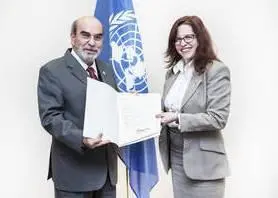
Cuban Ambassador to the United Nations agencies in Rome, Alba Soto Pimentel, formally presented FAO Director-General José Graziano da Silva with Cuba’s instrument of accession to the Agreement last week.
“Cuba’s accession to this international treaty is a sign of the political will of the Government of Cuba to contribute in an effective and concrete way in support of measures for the protection and sustainability of ecosystems and the preservation of marine biodiversity,” Ambassador Soto Pimentel said.
The Agreement, which will create binding obligations, comes into force when 25 countries or regional economic blocs have deposited their instrument of adherence with the FAO Director-General. With Cuba’s adherence 23 countries and the European Union, on behalf of its members, have deposited 24 instruments of adherence. Among the latest are Barbados, Guyana, Republic of Korea, South Africa and the United States.
Mr Graziano da Silva has expressed confidence that the target of 25 could be reached by July this year.
Illicit fishing may account for up to 26 million tonnes a year, or more than 15%, of the world’s total annual capture fisheries output. Besides economic damage, such practices can threaten local biodiversity and food security in many countries.
Port State measures set standards for inspection of foreign vessels that seek to enter the port of another State. Importantly, the measures allow a country to block ships it suspects of having engaged in illicit fishing and thereby prevent illegal catches from entering local and international markets..
Related Articles
 FISHERIES
 FISHERIES
 WORLD FISHING EVENTS