






Wild salmon catch up whilst farmed sector struggles
Wild catch of salmon and related species has risen by 7% to 5.2 million tonnes in 2023, according to seafood data analyst, Kontali.
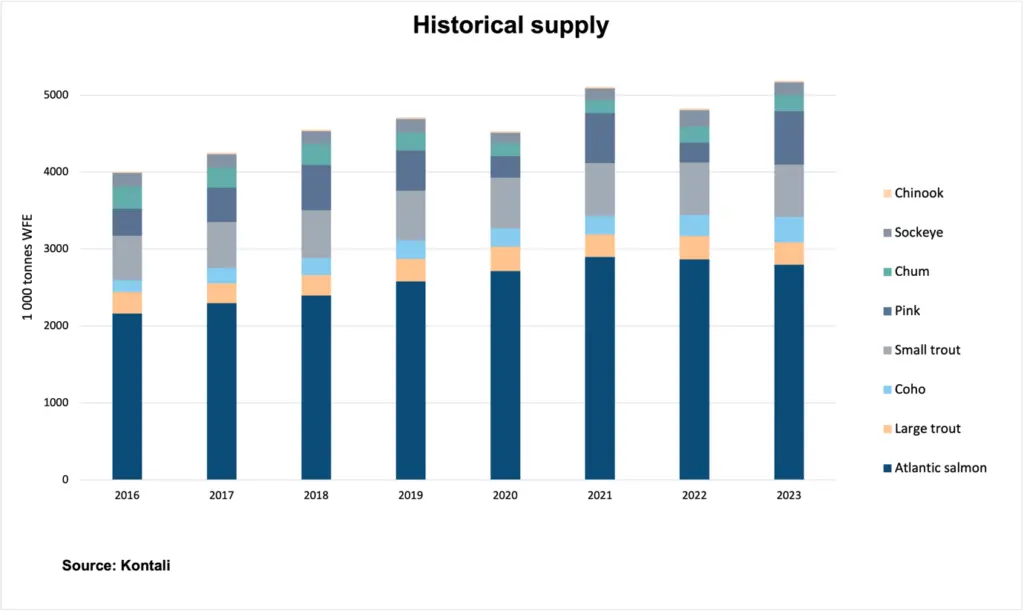
The increase in wild catch was driven primarily by pink salmon which is up 169% to 690,000 tonnes.
In contrast the farmed sector has remained fairly stable with a slight decrease of 0.8% compared to the previous year.
“The challenges in 2023 are hanging over the industry and impacting 2024,” said Filip Szczesny, senior analyst, Kontali.
“Despite efforts to address these issues, 2024 began with low biomass, and the limited growth from 2023 further reduces harvest potential this year. While land-based production has shown promise, it is still in its early stages and hasn’t significantly impacted global salmon production.”
Two thirds of farmed salmon is produced by the top 15 firms. Mowi maintained its position as the largest player, holding an unchanged 15% share of total farmed salmonid volumes.
In the Atlantic farmed salmon sector, harvest volumes decreased for the second consecutive year, dropping by 2% to 2.79 million tonnes in 2023.
Norway, the largest producer, saw a 2.5% decline to 1.48 million tonnes, whilst Chile increased its production by 2% to 760,000 tonnes. Canada experienced the largest production decline, down 17%, whereas Russia recorded a 9% increase.
Supply trends
Atlantic salmon exports to the US market stagnated in 2023 after seven years of continuous growth. In the largest market for Atlantic salmon, the EU and UK market, supply decreased by nearly 5% to 1.2 million tonnes. The Japanese market continued to decline, down 19%, whilst the Russian market recovered, from a close to record low level.
Related Articles
 PROCESSING & REFRIGERATION
 FISHERIES
 FISHERIES