



Frozen fish sorting – 3D sensor technology leads the way
Processing, sorting and categorising fish are essential steps in the seafood industry, helping to ensure that fish are sorted in a way that maximises their economic value, and that only the best quality fish are sold to consumers.
However, performing these steps manually can be challenging. For example, manual sorting relies heavily on workers’ skills and judgement, which can potentially lead to inconsistencies in product size and weight. The work is also time- and labour-intensive, especially when large quantities are involved. There is also a high risk of contamination. With more hands required to hasten the manual sorting process, the risk becomes higher, compromising product safety and hygiene, and reducing the quality of products that are released to the market. Finally, the need for workers and longer processing times drives up operation costs and, as a result, the price of the final product, while inefficiencies in manual sorting can lead to more waste and extra work, further adding to production expenses. The proper visual classification of fish is also a difficult undertaking, especially when they have been frozen. Differences between species become practically impossible to detect reliably without exhaustive testing.
In order to help the seafood industry tackle these challenges, various technological innovations are emerging to streamline processes, reduce waste and cut costs. One company that has come up with such an innovation is Zebra Technologies, a US digital solutions manufacturer, which has produced a series of 3D profile sensors called Altiz, to enable seafood processors to achieve near-perfect visual inspection accuracy rates.
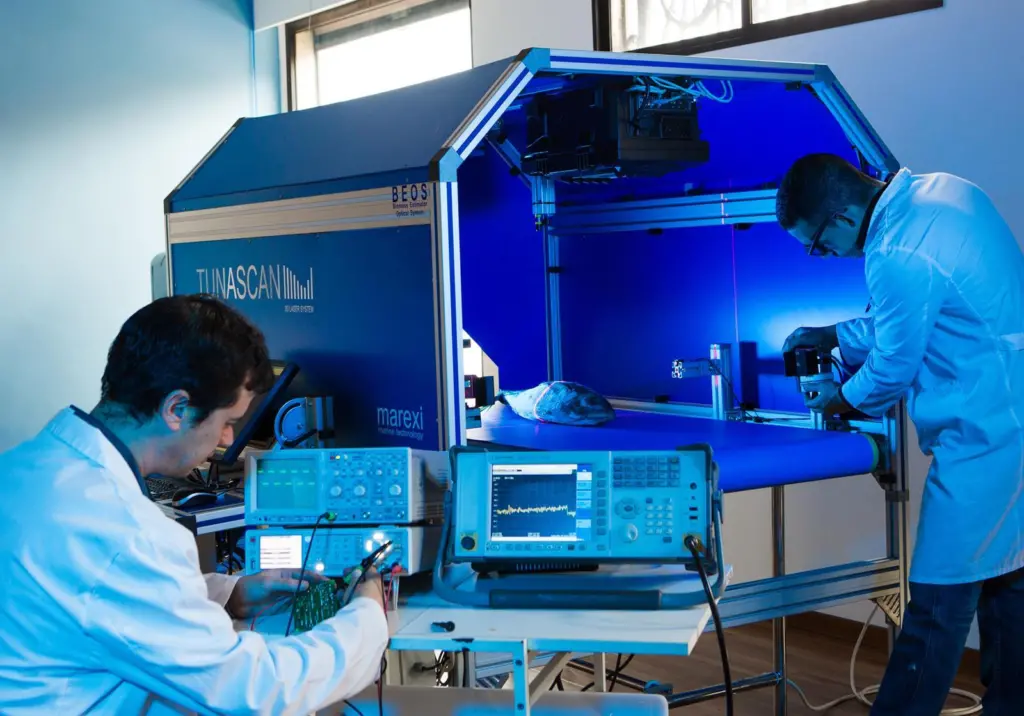
Meanwhile, Spanish technology firm Marexi Marine Technology has been producing optical scanning systems for marine species for over 15 years. Using Zebra Technologies’ Altiz sensors, the company has developed a 3D imaging system known as TUNASCAN for the high-speed classification and sorting of frozen tuna. Developed and refined over five years, the system allows up to 20 tonnes of frozen tuna per hour to be accurately classified by species, size and quality.
“In the past, large processing facilities that could process up to 200 tonnes a day required more than 20 people to classify frozen tuna,” Joaquín Gracia Salvador, President of Marexi, told WF. “Operators would have to classify different species such as big eye, yellowfin and skipjack by type, weight and condition. Needless to say, this was time consuming, labour intensive and subject to human error. Some species, such as skipjack, can be recognised by visual inspection when frozen, but visual inspection can become less accurate and more testing may be required when it comes to other species like yellowfin and bigeye. This is one of many challenges that we want to address, which is why we designed and developed the TUNASCAN system.”
“Sorting the fish manually is only 40% accurate, but this figure has improved by over eight times thanks to the TUNASCAN system,” Salvador continued. “The customer is also supplied with the correct product – quality and species – that can be priced accordingly. The TUNASCAN system is our most state-of-the-art machine, a high-speed, high-throughput vision system.”
Smart sorting
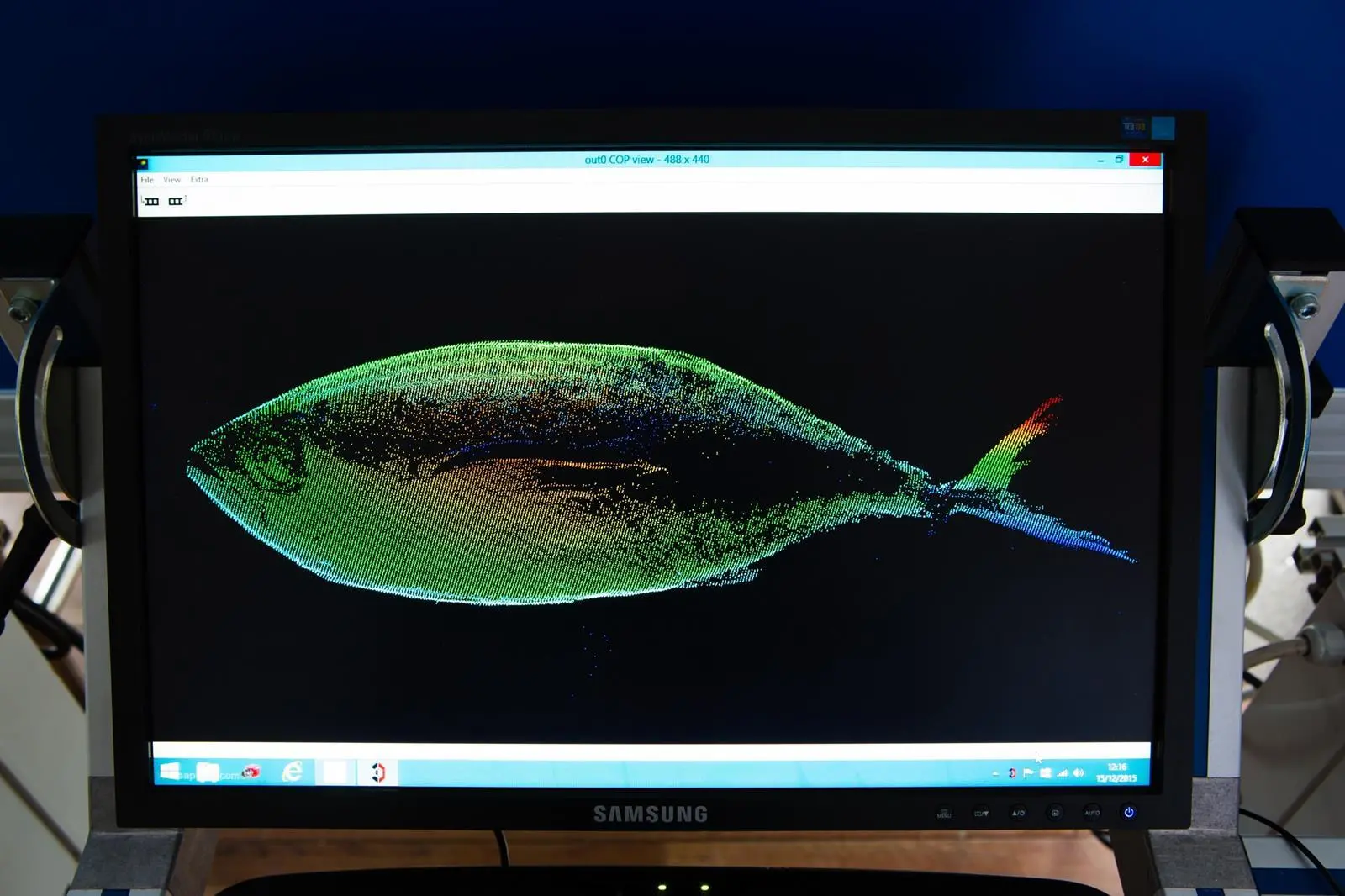
The TUNASCAN system’s scanning and classification are divided into three sections: reception hopper, scanning and sorting. From the reception hopper, frozen tuna are fed into the system before passing through a conveyor scanning section. Once there, two Altiz sensors perform a 3D scan, and a computer algorithm classifies each tuna individually. The classification results and location data are then sent to the sorting system, where each tuna is placed into an appropriate container.
“To characterise which type of tuna is present, over 80 different measurements must be made, including weight, the shape and size of the fish, and more complex measurements such as the distance between the head and the dorsal fin,” said Salvador. “Once these measurements have been made, they can be used to classify which type of fish is present. The 80 extracted characteristics and measurements are classified using machine learning, which is custom-designed by Marexi to run on an NVIDIA co-processor in the PC.”
The TUNASCAN system is efficient and reliable, requiring minimal maintenance under continuous operation. The sensors offer a robust and reliable way to capture detailed 3D data on moving objects, significantly improving the accuracy of the classification and sorting process.
Operator interaction with the TUNASCAN system is also minimal. An easy-to-use human-machine interface (HMI) lets the operator choose output categories by species and weight, so that in addition to sorting by species, the same species of tuna can be sorted into different groups according to their weight.
The amount of time it takes to classify and process the fish is also a fraction of that needed for manual inspection. This time saving is especially important when dealing with items like frozen food that must be kept cold to ensure consumer safety.
The TUNASCAN system automatically sorts every incoming fish into selected categories by container. When a container is full, the operator is informed so that the full container can be removed from the line and a new one added. Multiple containers can be managed at the same time, ensuring that the system operates continuously, while every component that comes into contact with the frozen tuna, such as conveyor belts, is certified for food safety.
Adding value
To date, several TUNASCAN machines have been installed in tuna processing companies and run continuously from Monday to Friday in three 8-hour shifts per day, said Salvador. The robustness and reliability of the TUNASCAN system allow the quality standard of processed tuna to be raised to levels of excellence, offering products with a high added-value.
“Our focus is to listen to our clients, analyse their needs, and design the best solution while continuously collaborating with leading companies and their partners,” said Salvador.
“After a long process of internal design and development, a prototype emerges, and after a series of tests and adjustment at the client’s location, taking into account their comments and impressions, the product in question evolves until it becomes a pre-commercial device. This also enables our clients to feel involved from the beginning, and be part of the development of something that is adapted to their own needs. As we investigate other processing solutions, we are always looking to optimise our applications to improve our products and increase their performance.”
Building on the success of the TUNASCAN system, Marexi is now working on different computer vision AI projects for the seafood industry.
“At Marexi, we continue to develop new AI solutions, applying computer vision technologies,” said Salvador. “At the moment, we are finalising some high-tech devices that, by applying precision robotic engineering, associated with our AI algorithms embedded in computer vision systems, can for example, automatically peel cooked tuna or other species of cooked or frozen fish. Work is also underway to automatically separate portions of fish that are infected with the anisakis parasite, before packaging takes place. Our work is key to helping our clients achieve high accuracy levels in inspecting and classifying frozen food, and we are delighted with the TUNASCAN system’s performance so far.”
Related Articles
 PROCESSING & REFRIGERATION
 SEAFOOD
 SEAFOOD